
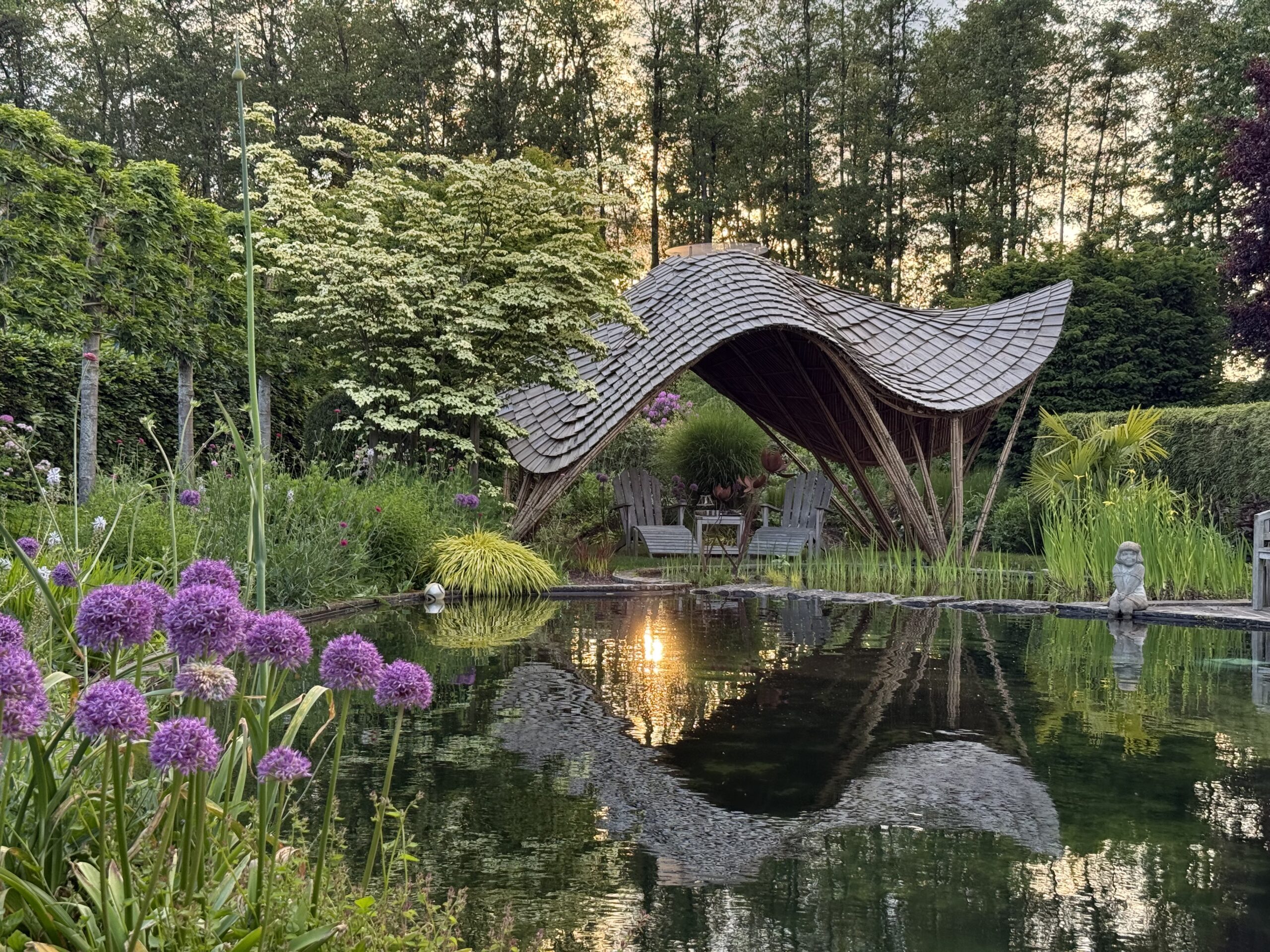
Nest Architecture: Building with harmony and humanity
When you enter the world of bamboo construction, it doesn’t take long to see that it’s about more than just an alternative building material, it’s about a whole different way of thinking. From workshops in Bali to pavilions in Colombia, a bamboo building revolution has been underway for a few decades, and it promises to change the way we engage with the spaces we occupy. Europe may not have the richest bamboo forests, but when it comes to promoting innovative design and adopting a holistic approach to the built environment, few can set a better example than Charlotte Dubois, founder of Nest Architecture in Belgium.
Charlotte has spent most of her professional life in the world of traditional European architecture. But after travelling and spending time in Colombia, Costa Rica, Southeast Asia, Morocco and Spain, her eyes opened to the extraordinary potential of bamboo. Through a series of what others might call coincidences, she learned to work with Guadua in Latin America, participating in various bamboo building workshops, exploring innovative designs with the Ekawa Bamboo Lab in Colombia and taking an online design workshop with Bamboo U, based in Indonesia. She also went on to attend building courses in southern Spain with Arundo donax (a close cousin to bamboo that grows widely around the Mediterranean), and soon after discovered that she was living just around the corner from one of Europe’s largest bamboo nurseries, in her hometown of Antwerp.
From the gray skies — and gray concrete architecture — that dominate northern Europe, Charlotte’s adventures across the tropics and the balmy Mediterranean opened up a whole new world of possibilities. While she was already familiar with the environmental advantages of materials like hemp and straw, bamboo proved the perfect material to express her creativity. And more importantly, she came to appreciate the powerful impact of the built environment, not only on global health, but also on our personal health, and how it influences the way we act and feel.
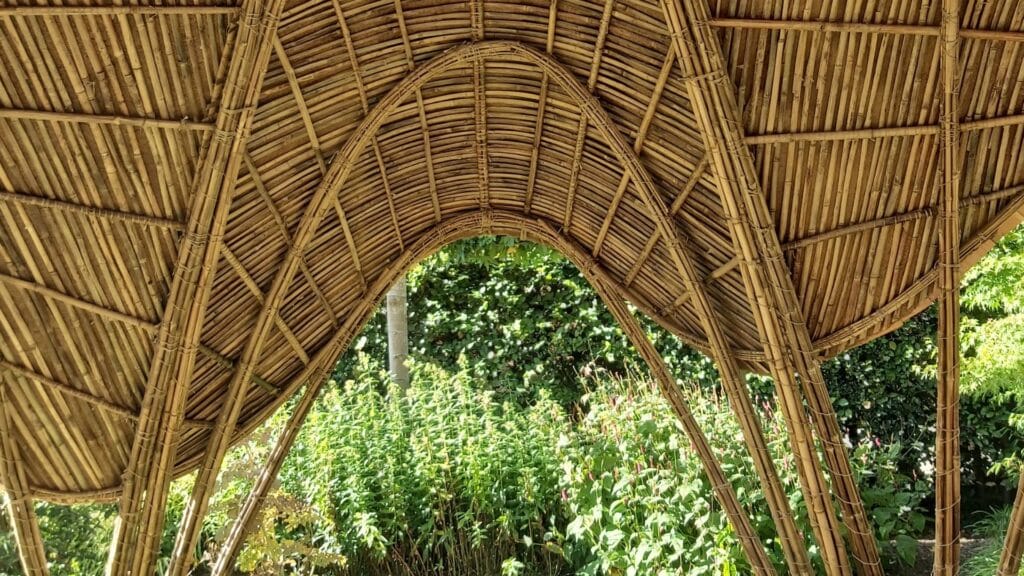
Much of Charlotte’s work comes from what she calls, in the words of John Hardy, “the architect’s responsibility to reclaim the role of being an artist.” Long frustrated by the limitations of conventional architecture, bamboo rekindled the sense of artistic freedom that she was craving. Of course, Nest Architecture isn’t in the business of designing residential apartments or commercial office complexes. And therefore, they aren’t bound by the strict building codes and regulations required for more permanent structures. Instead, driven to “make artistic expressions of space,” they focus on more inventive installations that enhance the way we come together and relate to our surroundings, guided more by social principles than commercial objectives.
Holistic Bamboo Architecture
Like so many bamboo builders in the 21st century, Charlotte takes much of her inspiration from pioneers like Simón Vélez and John Hardy. While respecting the engineering essentials to ensure structural integrity and stability, Charlotte’s garden pavilions place equal or greater emphasis on aesthetics and harmony with the surroundings.
Before designing or installing any structure, Charlotte carefully studies the lay of the land, the view lines, and the path of light and shadows. She insists on creating “a natural element that weaves itself into the landscape.”
One of her more exceptional designs even takes the wind into account, harnessing nature’s breath to turn the buildings themselves into musical instruments. This structure, called the Temple of the Wind, features small holes drilled into the bamboo poles, allowing them to resonate and sing like flutes as the breeze blows, producing different tones as the wind changes speed and direction. In a way, these temples are co-created with the elements, incomplete until nature has let her voice be heard.
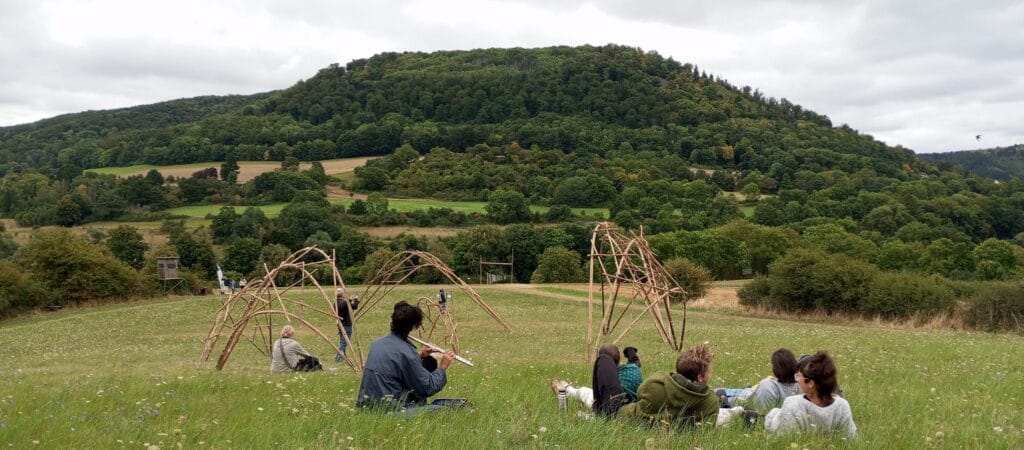
In fact, co-creation is at the heart of everything Nest does. Charlotte’s passion for bamboo building shines most brightly when she describes her “architecture for shared humanity.” As an example, last month (August 2026), Charlotte was working on a community garden project in Antwerp, in conjunction with a larger effort to help newly arrived residents from distant corners of the globe to learn Dutch and integrate into society. As expected, the final result was a beautiful bamboo garden pavilion, but the real purpose was as much about bringing people together for the collective process of creation.
Bamboo is widely recognized as an important resource for addressing climate urgency, but Charlotte is equally concerned about “social urgency”. She describes how hard it is to find community events and gathering places that aren’t somehow tied to consumerism and spending money. Faced with a relentless onslaught of stimulation, in constant competition for our attention, society is becoming increasingly fractured, and opportunities to come together in real life in shared space are becoming woefully rare.
Charlotte’s “slow and mindful” building projects promise a direct remedy to that. The week-long workshop in Antwerp brought together people of diverse backgrounds, collaborating in the physical construction, but also creating a shared experience to remember, laughing and telling stories throughout the process.
Sourcing Local Bamboo
With such a meaningful connection to the local landscape and local community, it comes as no surprise that Charlotte should insist on sourcing her bamboo building materials exclusively from Europe, as locally as possible.
Although none of the 1600+ species of bamboo is native to Europe, exotic horticulturalists introduced the plant to the continent in the nineteenth century, and its footprint has steadily expanded through the enthusiasm of gardeners and collectors. In many cases, poor planning has resulted in unwanted patches of expansive Asian bamboo that property owners are keen to remove.
By harvesting these dense groves, Charlotte and her team are able to source the material they need while providing a complementary service to those for whom the bamboo has fallen out of favor. At the same time, they provide a bit of education on proper bamboo management and containment practices, to help prevent this otherwise beneficial plant from becoming an unpopular nuisance.
As luck would have it, Antwerp is also home to Jan and Mark Oprins, internationally acclaimed bamboo specialists and founders of Vista Verde Bamboo Nursery. In her life of serendipities, it didn’t take long for Charlotte to cross paths with these bamboo impresarios, and so now she never struggles to find a steady source of sturdy culms.
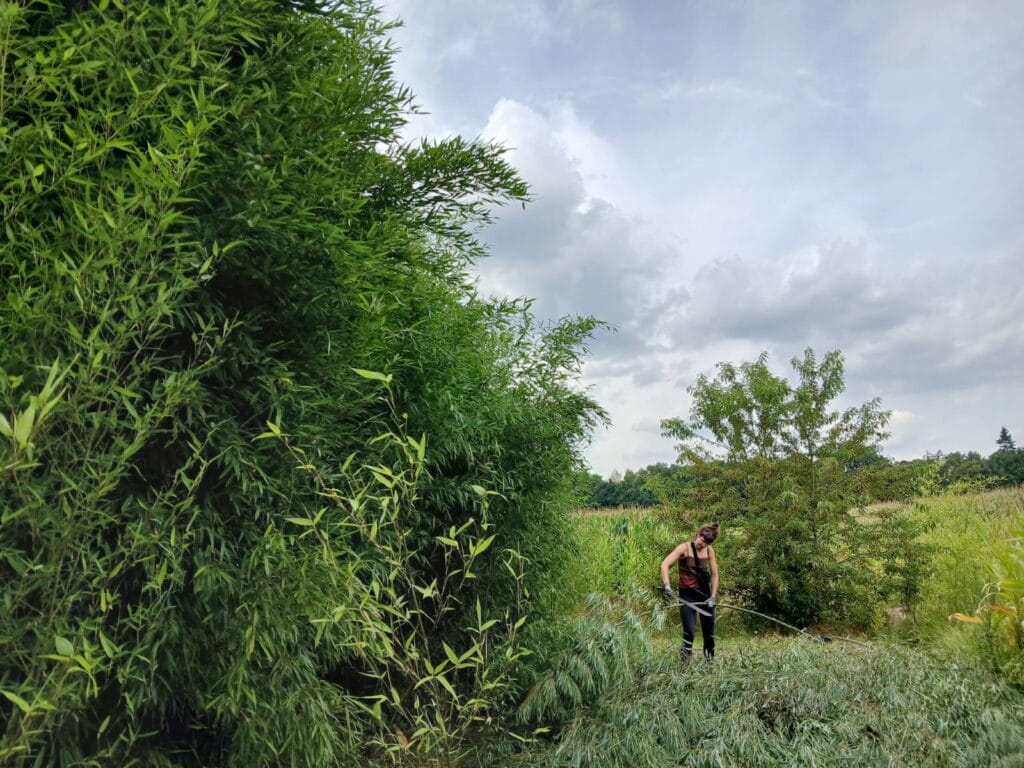
The colder climates of northern Europe are not suitable for the massive timber varieties that Charlotte worked with in Colombia and Southeast Asia, but many species of fast-growing Phyllostachys thrive here. And though they rarely reach the impressive diameter of Guadua or Dendrocalamus asper, expert bamboo designers have no difficulty overcoming that limitation. Nest’s structures commonly feature bundles of thinner poles bound together, providing equal or greater strength than giant bamboo, while offering far more flexibility to create those sweeping curves that make their pavilions so graceful and attractive.
As bamboo continues to gain recognition for its strength, utility, and all-around environmental superiority, Charlotte Dubois and Nest Architecture are showcasing the very best of what this remarkable grass has to offer. Whether you’ve studied bamboo your whole life (like me), or you’re just discovering it for the first time, you will surely be captivated by these stunning designs and the beautiful intentions behind them. For environmental, aesthetic, or social impact, they prove, once again, that the only limit to what can be accomplished with bamboo is your imagination.
Fred Hornaday has been active in the bamboo industry since 2006. He is the founder of Bambu Batu and Editor-in-Chief at the European Bamboo Foundation.