
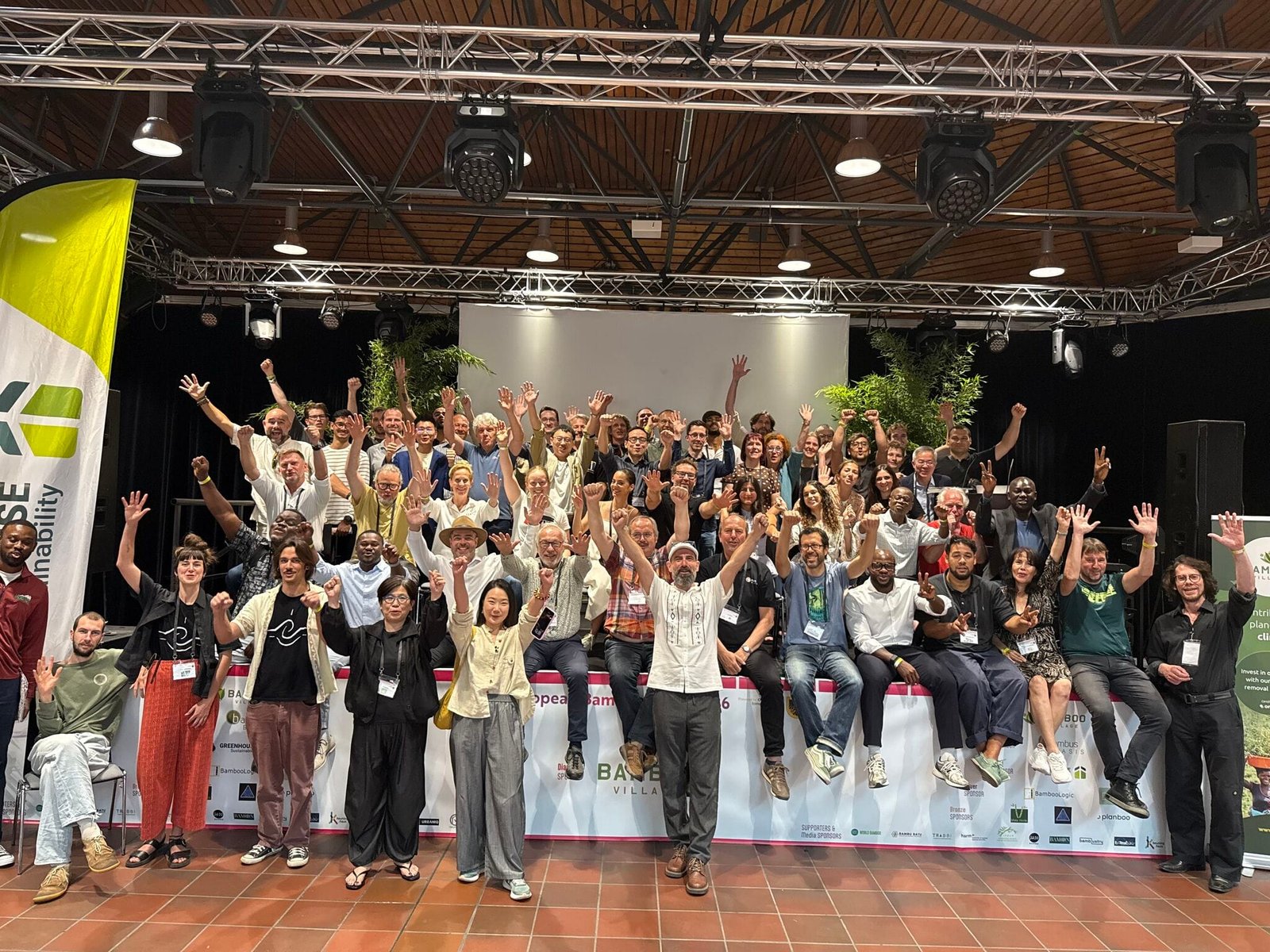
Reflections on the European Bamboo Expo
At first glance, the 4th European Bamboo Expo felt smaller than previous editions. Fewer attendees filled the aisles and seats, and a refreshing sense of calm prevailed. Yet by the end of the two days, everyone was praising the quality of the event and many were commenting on the opportunities for deeper and more meaningful conversations.
What the expo may have lost in size and scale (for reasons I’ll get into later), it surely gained in focus. And if the discussions I had throughout the week are any indication, the European bamboo sector is entering a new phase. While past events exhibited more starry-eyed enthusiasm, this year we saw greater attention paid to collaboration, implementation, and long-term institution building.
A Broad Range of Perspectives
What I really appreciated this year was the well-rounded diversity of topics represented. Presentations covered construction, engineering, horticulture, social impact, disaster relief, and emerging applications for bamboo in Europe and abroad.
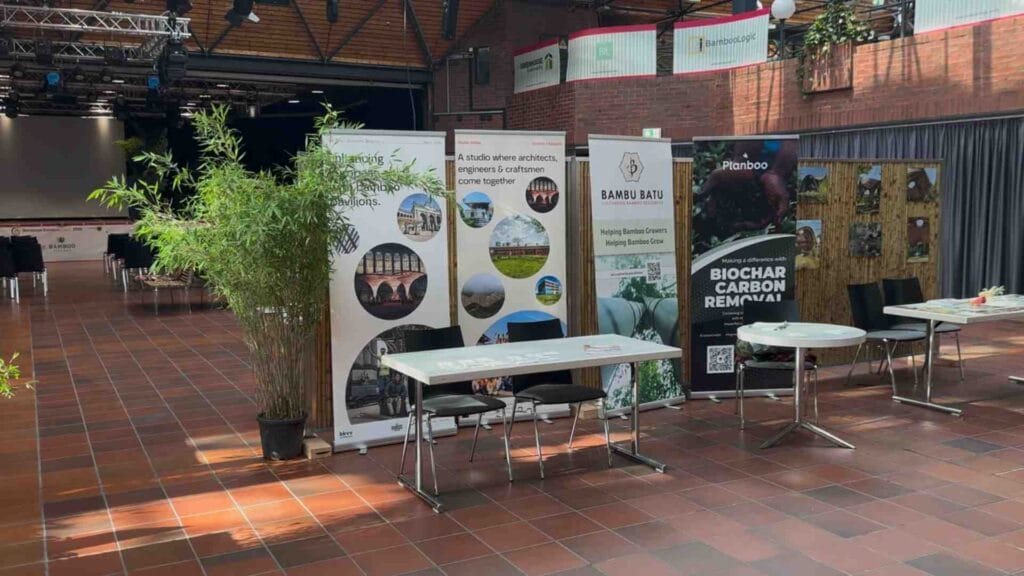
Among the projects that stood out most to me were Blue Temple’s refugee housing initiatives in Myanmar and One Nest’s temporary architectural structures from Belgium. Both demonstrated bamboo’s versatility as a building material that can harmonize with real-world conditions, but at opposite ends of the human spectrum. The One Nest installations by Charlotte Dubois seemed to attract attention throughout the event, as their booth’s vivid photography captured the innovative, collaborative spirit of bamboo at its best.
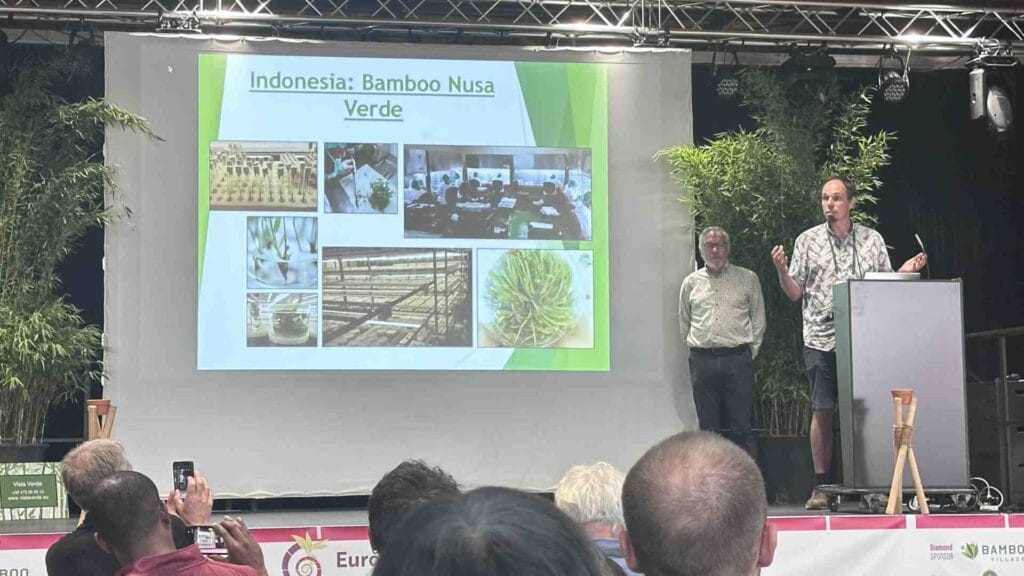
Of course, Luc Boeraeve’s exuberant discussion of ornamental bamboo horticulture tickled my botanical sensibilities. And this plant-based presentation was followed by a more scientific talk on large-scale bamboo cultivation from Jan and Mark Oprins, the father and son team from Vista Verde, a longtime pillar of the European bamboo community. In counterpoint, not surprisingly, we heard a lot of talk about harnessing the power of AI to aggregate research findings and unlock more of bamboo’s economic potential.
I was also pleased to contribute my own presentation on bamboo and biochar, a topic that continues to generate interest as growers and producers look for ways to improve soil health, create value from organic waste streams, and promote models of circular economy.
Beyond the Presentations
As always, some of the most valuable moments happened offstage, in the free and lively conversations taking place around the water cooler and the coffee counter.
Having run in the bamboo circles for so many years, these sorts of events start to feel a bit like family reunions, the coming together of old friends and kindred spirits. That’s all well and good, but for this industry to really break out and penetrate the mainstream economy, we need fresh faces and new alliances. So, I was especially delighted to hear about new projects in Haiti and Sierra Leone, and to speak with first-time attendees from US hubs like Athens and Miami, as well as Silicon Valley. So I was especially delighted to hear about new projects in Haiti and Sierra Leone, and speak with first-time attendees from American cities like Athens, GA, and Miami, FL, as well as Silicon Valley, CA.
Travel restrictions and geopolitics prevented many regular visitors from Asia from attending, but I was still able to make time for my old friends and colleagues from Ghana, Guatemala, Uganda, and Mumbai. As a remote worker who consults on projects all over the world, I truly cherish these face-to-face meetings, shaking hands, sharing laughs and gathering for meals.
Common Themes
Because of bamboo’s unsurpassed versatility, we find people from all walks of life discovering it from all different directions. Still, we heard a number of recurring themes echoing throughout the conference.
Naturally, climate change is on everyone’s mind, as bamboo is a superstar of carbon sequestration and sustainability. So it’s frustrating to sense that bamboo is being deprioritized due to more urgent crises in Iran and Israel. For those of us at the Expo, however, it’s plain to see the connection between fossil fuel dependency and the wars in the Middle East. In fact, the need for renewable resources like bamboo has never been more acute.
On a brighter note, every project and presentation conveyed a clear commitment to working in harmony with nature. Whether discussing building materials, ecological restoration, or agricultural systems, speakers consistently emphasized the need for nature-based solutions to address human-created challenges. Circular economy and biomimicry were a couple of the common catchphrases for us to ponder.
Passion remains abundant within the bamboo sector, as expertise keeps growing and innovative projects continue to emerge. Yet one of the most conspicuous absences at the Expo was the limited presence of investors, buyers, and commercial off-takers.
For growers, processors, and entrepreneurs, this remains one of the critical bottlenecks. The challenge is no longer simply convincing people that bamboo has potential. Increasingly, the challenge is building the financial and commercial ecosystems needed to turn that potential into a scalable reality.
A More Mature Conversation
With a smaller and more intimate audience, I also got the impression that this year we were among a more serious cohort of bamboo visionaries. Some of the fair-weather bamboo enthusiasts might have had other plans for this unusually warm and sunny weekend, but for those of us who made the journey to Dortmund, the sense of commitment was palpable. These weren’t the casual, lukewarm daydreamers; this was a gathering of dedicated bambuseros.
Larger bamboo meet-ups often focus on the basic benefits of bamboo, getting newbies excited about the possibilities and aspirations. Those conversations remain important, but those in attendance this time brought with them the wisdom of their years. And with experience comes a greater willingness to face the material challenges, the practical obstacles, and the market realities.
In many ways, this reflects a healthier stage of development. An industry grows not only when it celebrates successes but when it critically evaluates what is working, what is not, and what needs to happen next.
Looking Ahead to Rotterdam 2027
Around midday on Thursday, esteemed event organizer Iraklis Kalamenios delivered a special announcement, informing us that after four years in Dortmund, the next European Bamboo Expo is taking place in Rotterdam. For five fun-filled days, June 7-11, 2027, the Expo will join forces with the renowned World Bamboo Congress and the popular Bouw Met Bamboe event. Surely, if you can only attend one bamboo event every couple of years, this is the one to plan ahead for.
Rather than having to choose between traveling to a bamboo industry convention, construction workshop, or academic research event, bamboo aficionados can check all three boxes with one ticket. The consolidated bamboo extravaganza is sure to attract more visitors and presenters from all sectors of bamboo, opening opportunities for an even greater range of partnerships and collaboration than ever before.
Visit worldbamboocongress.org for complete details.
At the same time, discussions have begun around the creation of a European Bamboo Foundation (EBF), yet another indication that the industry is evolving through increased cooperation and shared purpose. And if you’re reading this, then you’ve found my first contribution to this new foundation as an Editor.
While other scattered bamboo societies have struggled to spur engagement and maintain membership, the EBF promises to learn from those organizational forerunners, shifting the focus to creating a platform that can foster collaboration while also directing policy and facilitating the funding.
While details are still solidifying, the central idea is clear: Europe needs stronger mechanisms for collaboration, policy development, funding acquisition, and long-term project support. Many bamboo organizations have historically relied on volunteer efforts, often struggling to maintain momentum over time.
The foundation in formation aims to take a different approach by actively pursuing grant funding and investment opportunities that can support meaningful participation and help transform volunteer enthusiasm into sustained action. If successful, such an organization could help accelerate bamboo cultivation, processing, construction, research, and policy development throughout Europe.
Reasons for Optimism
International industry conferences can be exhausting, with presentations running back-to-back-to-back, and participants trying to capitalize on every free minute to network with as many contacts as physically possible. But this year’s European Bamboo Expo put quality over quantity, and I walked away from it feeling anything but drained. On the contrary, I felt charged, inspired, and ready to direct my skills and energy where I believe they can make the greatest impact.
No, we haven’t removed every bottleneck and solved every problem, but we spoke honestly and authentically about the challenges as well as the opportunities. With conversations becoming more focused, more realistic, and more collaborative, the path to progress feels more tangible. The dreams are still alive, but they are increasingly accompanied by serious questions about markets, investment, policy, and implementation.
Fred Hornaday has been active in the bamboo industry since 2006. He is the founder of Bambu Batu and Editor-in-Chief at the European Bamboo Foundation.